The Shift Toward Ultra-High Density
As data centers transition toward 1.6T and 3.2T architectures, fiber density is no longer increasing linearly—it is accelerating. What used to be a manageable number of patch cords within a rack has now grown into thousands of individual connections compressed into the same physical footprint.
.jpg "high density data center fiber cabling infrastructure")
This shift is further intensified by AI and high-performance computing workloads. Industry projections indicate that data center energy consumption could double by 2026, placing unprecedented pressure on infrastructure design.
Against this backdrop, the physical layer is no longer just a transmission medium, but a critical determinant of system scalability, maintainability, and operational reliability.
This leads to a fundamental question:
can conventional patch cord routing still sustain modern high-density fiber infrastructures?
Why Patch Cord Routing Becomes Unmanageable at Scale
From Flexibility to Uncontrolled Complexity
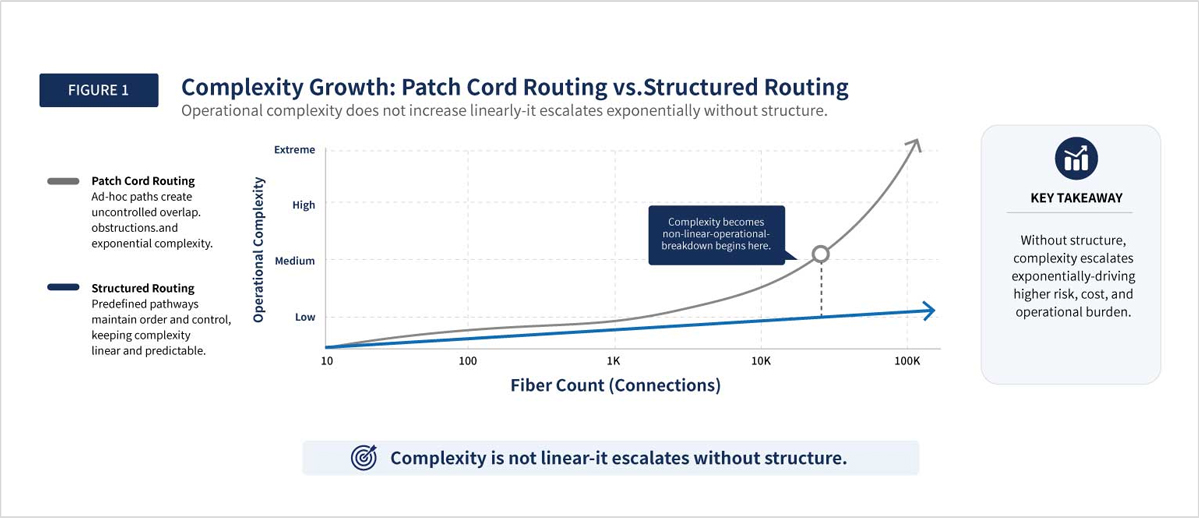
The limitation of conventional patch cord routing is not rooted in technology, but in structure. It was designed for flexibility in low-density environments, where manual routing decisions remain manageable.
The Rise of Ad-Hoc Patching
At scale, however, this flexibility transforms into uncontrolled complexity. Routing becomes improvised rather than designed, often taking the form of ad-hoc patching—where cables are run directly from point A to point B without predefined paths.
In dense environments, this results in visually chaotic cabling layouts that are difficult to interpret and manage.
.jpg "unstructured patch cord routing in high density fiber environment")
Ad-hoc patching in high-density environments leads to chaotic cabling layouts that are difficult to manage and scale.
What emerges is not just “messy cabling,” but a high-entropy environment where:
· the physical layer becomes a black box that is difficult to interpret
· maintenance effort grows non-linearly
· troubleshooting shifts from minutes to hours
In such conditions, the problem is no longer density itself, but the loss of control over system behavior.
Physical Constraints Driving Routing Complexity
Space and Density Limitations
This breakdown is driven by the interaction between physical constraints and unstructured, ad-hoc routing practices.
Bend Radius and Signal Integrity
Without predefined pathways, fibers naturally follow convenient routes, leading to overlapping and tangled layouts. As density increases, space limitations make it difficult to maintain proper bend radius, introducing macro- and micro-bending losses that directly impact signal integrity. This issue has been highlighted in high-density applications across the industry.
Cable Volume and Access Challenges
At the same time, cable volume grows faster than expected. Each additional connection does not just add complexity—it compounds it, making access, identification, and management increasingly difficult.
System-Level Impact of Unstructured Routing
The effects of uncontrolled routing extend far beyond physical disorder.
Maintenance and Troubleshooting
Maintenance becomes slower and riskier, with technicians forced to manually trace connections in dense environments. This significantly increases the likelihood of human error, which is responsible for nearly 40% of major outages according to industry reports.
Thermal and Airflow Impacts
Thermal performance is also affected. Disorganized fiber bundles can obstruct airflow, creating hotspots and reducing cooling efficiency. Given that cooling accounts for a substantial portion of total data center energy use, the impact is far from negligible.
Downtime Risk and Operational Cost
From a business perspective, the consequences are even more severe. Downtime costs can reach hundreds of thousands of dollars per hour for many enterprises, and significantly more in critical sectors.
Ultimately, scalability is constrained. Each new connection introduces disproportionate complexity, making further expansion increasingly difficult.
Rethinking Routing: From Flexibility to Structured Control
Structured Routing vs. Ad-Hoc Patching
To overcome these limitations, the industry is shifting toward structured routing approaches. This transition reflects a broader principle seen across engineering systems: as complexity increases, structure becomes essential.
Modular Solutions for High-Density Fiber Management
In practical deployments, this approach is implemented through solutions that introduce predefined and repeatable fiber pathways. Platforms such as the Fiber Optic Flex Circuit (FOFC) , Shuffle Module, Shuffle Cassette and FOFC Shuffle Enclosure are designed to replace ad-hoc patching with structured routing architectures, enabling controlled fiber organization in high-density environments.
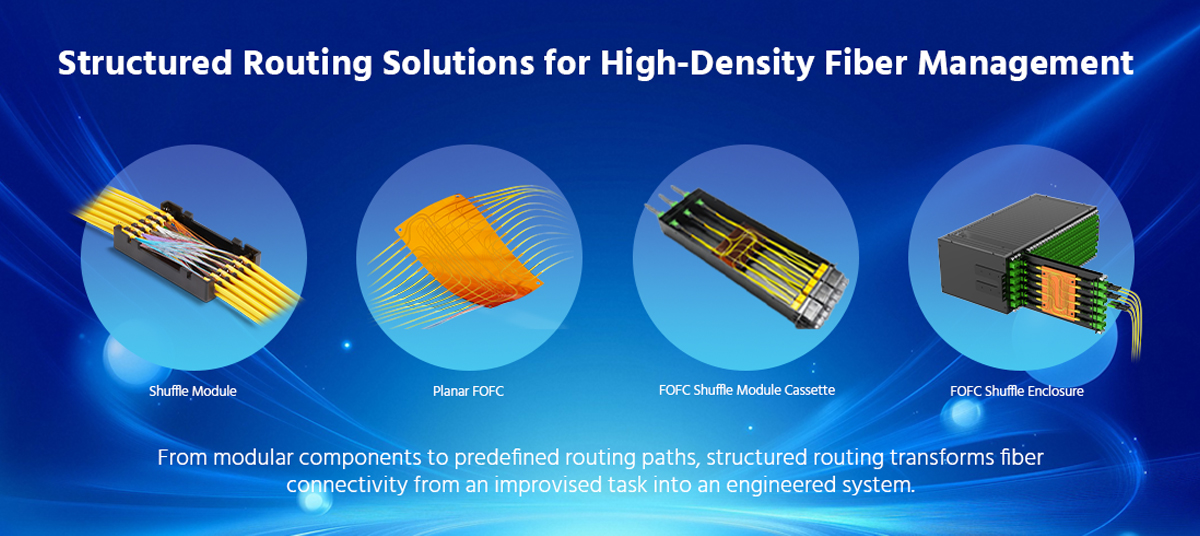
By transitioning from point-to-point improvisation to modular routing frameworks, these solutions help restore consistency, predictability, and system-level control.
Engineering Trade-Offs: Flexibility vs. Control
This transition introduces a clear trade-off between flexibility and long-term system control. The difference becomes more evident when viewed from an engineering and operational perspective:
Approach | Flexibility | Control | Scalability | Deployment Complexity |
Patch Cord Routing | High | Low | Limited | Low |
Semi-Managed Routing | Medium | Medium | Moderate | Medium |
Structured Routing | Lower | High | High | Higher |
At first glance, conventional patching appears advantageous due to its simplicity. However, this perspective changes when operational factors are considered.
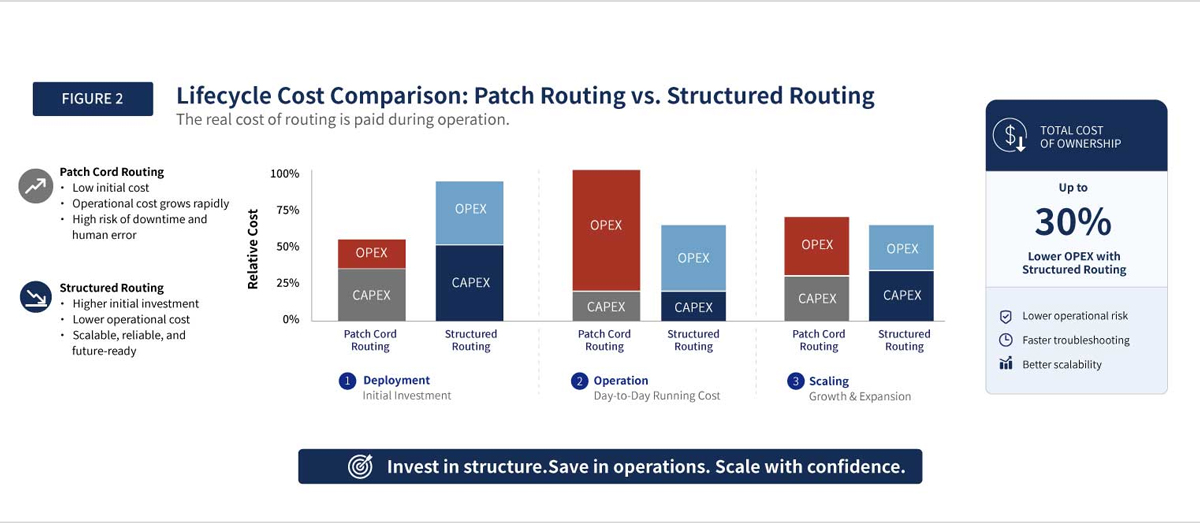
Beyond CAPEX: A Data-Driven Comparison
When evaluated across the system lifecycle, structured routing demonstrates clear advantages:
Dimension | Conventional Patching | Structured Routing |
Initial Cost | Lower upfront investment | Higher upfront investment |
Operational Cost | Increases non-linearly with scale | Up to 30% lower OPEX |
Troubleshooting | Time-consuming, manual tracing | Fast, structured identification |
Scalability | Limited, congestion-prone | Designed for expansion |
Downtime Risk | High (human error, accidental unplugging) | Significantly reduced |
This comparison highlights a critical insight:
the real cost of routing is not paid during installation, but during operation.
Why Structured Routing Becomes Inevitable
As systems scale, flexibility alone is no longer sufficient. Structured routing becomes necessary to restore predictability and maintain control.
By introducing defined pathways, standard interfaces, and modular design, structured routing transforms the physical layer into a manageable system. It aligns with the same design principles found in network protocols and software architecture, where structure replaces improvisation as complexity grows.
In this sense, structured routing is not simply an optimization—it is an enabling condition for scalability.
From Cable Management to Complexity Management
The real shift taking place is conceptual. The challenge is no longer to manage individual cables, but to manage the complexity they collectively create.
This requires moving from reactive organization to proactive design. Approaches such as modularization, high-density trunk consolidation, and logical abstraction all serve to reduce the number of variables in the system.
In this context, modular routing platforms—such as shuffle-based architectures—play a key role in translating these principles into deployable infrastructure.
Standardization and integration with DCIM systems further ensure that the physical layer remains consistent, traceable, and aligned with its intended design.
Conclusion
Build Scalable, Reliable High-Density Fiber Infrastructures
Conventional patch cord routing was developed for environments where flexibility was sufficient and complexity was limited. In today’s high-density data centers, those assumptions no longer hold.
As fiber counts grow and system requirements evolve, unstructured routing introduces congestion, operational risk, and scalability constraints.
Structured routing represents a fundamental shift—from flexibility to control, from improvisation to design. It provides the foundation required to build scalable, reliable, and high-performance optical infrastructures in an increasingly complex environment.
The data shown represents typical scenarios and is intended to illustrate general trends. Actual results may vary depending on system design and deployment conditions.
 EN
EN
 jp
jp  fr
fr  es
es  it
it  ru
ru  pt
pt  ar
ar  el
el  nl
nl 
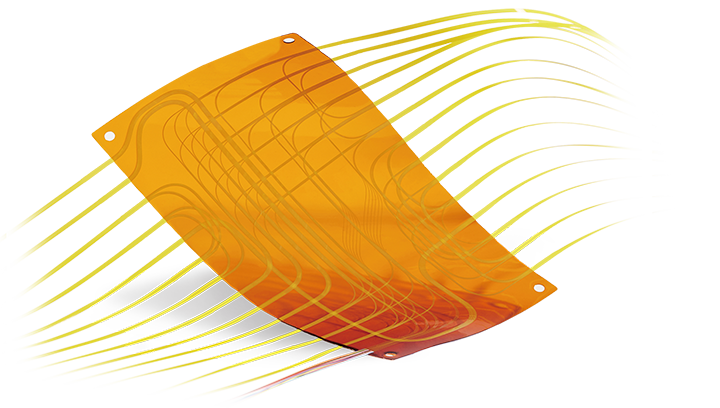 Fiber Optic Flex Circuit (FOFC)
Advanced Simulation & Optimization, High Positioning Accuracy, Flexible Customization, Rigorous Reliability Testing
Fiber Optic Flex Circuit (FOFC)
Advanced Simulation & Optimization, High Positioning Accuracy, Flexible Customization, Rigorous Reliability Testing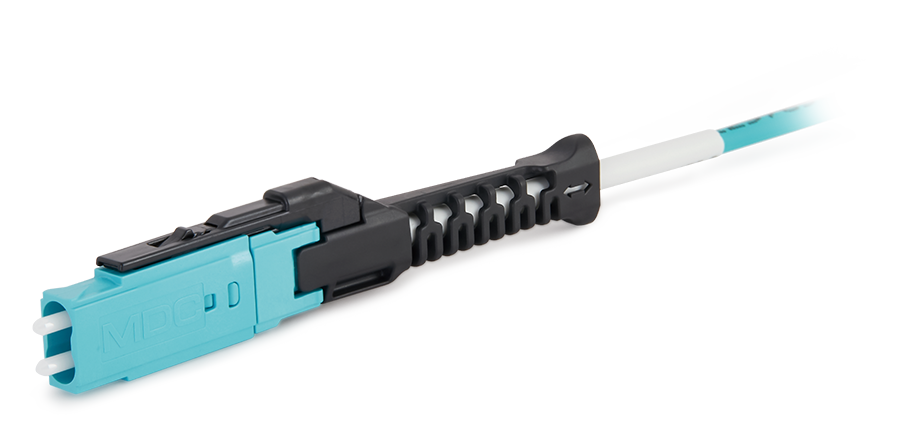 MDC Solution
US Conec's MDC connector is a Very Small Form Factor (VSFF) duplex optical connector, expertly designed for terminating single-mode and multimode fiber cables with diameters up to 2.0mm.
MDC Solution
US Conec's MDC connector is a Very Small Form Factor (VSFF) duplex optical connector, expertly designed for terminating single-mode and multimode fiber cables with diameters up to 2.0mm.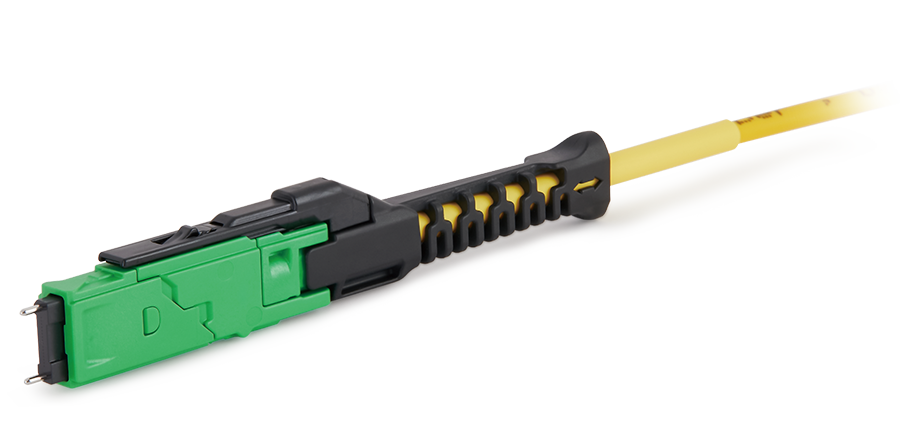 MMC Solution
US Conec's Very Small Form Factor (VSFF) multi-fiber optical connector that redefines high-density connectivity with its cutting-edge TMT ferrule technology and intuitive Direct-Conec™ push-pull boot design.
MMC Solution
US Conec's Very Small Form Factor (VSFF) multi-fiber optical connector that redefines high-density connectivity with its cutting-edge TMT ferrule technology and intuitive Direct-Conec™ push-pull boot design.