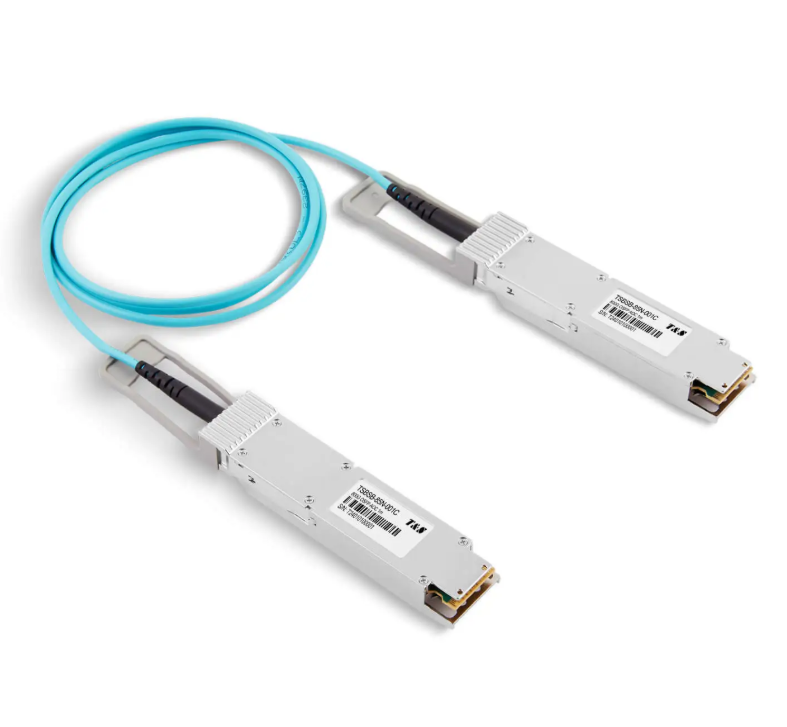
AOC (Active Optical Cable) is an integrated cable assembly. The optical transceivers are permanently attached to both ends of the fiber cable. It's a single, plug-and-play unit for short-reach connections (typically inside a rack).
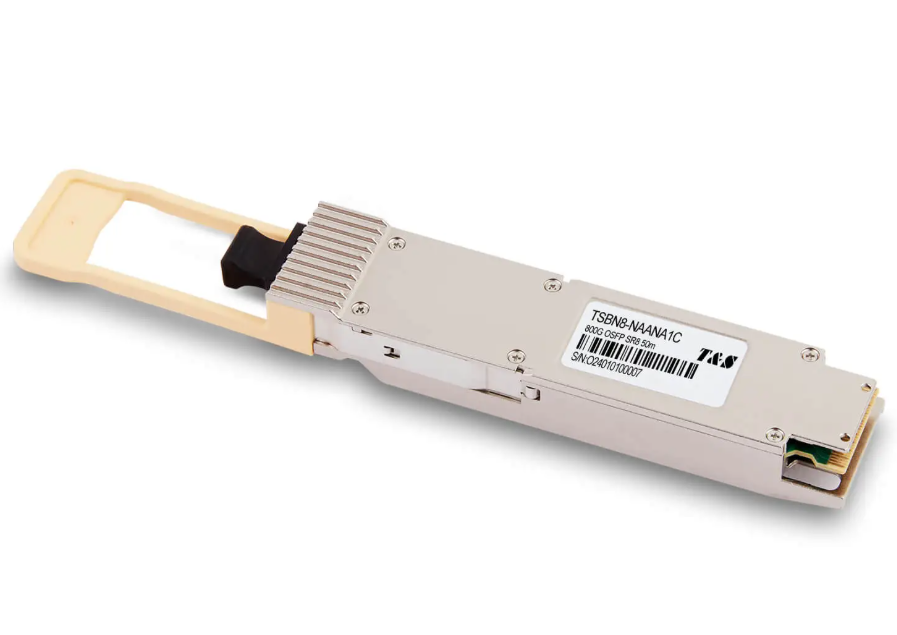
An Optical Transceiver is a modular, pluggable device. It inserts into a switch or server port, and you must separately connect a fiber cable to it. It is flexible and used for various distances (from short to long reach).
What is an AOC Cable?
An Active Optical Cable (AOC) is a factory-terminated, fiber optic cable assembly with embedded optical transceivers at both ends. It provides a complete, plug-and-play optical link solution. Compared to a configuration using two discrete optical transceivers and a separate fiber cable, AOCs typically offer lower total cost, higher reliability, and easier deployment, making them a popular choice for many applications.
What is an Optical Transceiver?
Optical transceiver modules, such as SFP+, QSFP28, QSFP56, QSFP-DD, etc., convert electrical signals to optical signals and are paired with separate fiber optic cables. Transceiver-based solutions remain dominant in enterprise networks, telecom systems, and long-distance optical connections.
Features of Optical Transceiver:
High flexibility: mix and match transceivers and cable types
Easy maintenance and component replacement
Support for short-reach, long-reach, and ultra-long-reach links
Interoperability across different equipment manufacturers
From a Technical Point of View, What is the Difference between AOC and Optical Transceiver + Optical Fiber?
Like an optical transceiver, an AOC performs electro-optical conversion. However, their design philosophies, component choices, and cost structures differ fundamentally, primarily due to the deterministic nature of the AOC link.
For a pluggable optical transceiver, as a universal interface, it must be designed to operate reliably with various unknown opposite-end transceivers and fiber links under diverse environmental conditions. Consequently, it requires high-performance, thermally stable lasers in hermetic packages and complex circuitry to meet stringent industry standards (MSA). Its manufacturing involves precision optical alignment to a universal connector interface, which is a highly automated but capital-intensive process.
For an AOC, the link is a fixed, point-to-point assembly with known and matched endpoints over a very short distance. This determinism allows for significant optimizations: it can employ lower-cost, non-hermetic chip-on-board (COB) optical engines, drastically simplified peripheral circuits, and a minimized mechanical housing. The optical coupling is optimized for this specific, short-reach link, allowing for higher coupling tolerances. Crucially, it eliminates two external fiber connectors and their associated alignment structures.
The Cost of AOC Active Optical Cable and Optical Transceiver is Different
While Active Optical Cables (AOCs) may offer an upfront cost advantage, they present notable operational and maintenance challenges when compared to pluggable transceiver solutions. As an integrated, non-serviceable assembly, an AOC cannot be repaired or partially replaced—if any single component fails, whether the transceiver, fiber, or connector, the entire cable must be removed and replaced. In densely wired environments such as data center racks, this often means disruptive re-cabling work, increasing both downtime and operational complexity. Moreover, AOCs lack the flexibility and interoperability required in multi-vendor networks. With pluggable transceivers, engineers can simply select compatible, vendor-coded modules for each end as equipment changes. By contrast, AOCs must be pre-programmed with specific vendor codes during manufacturing and carefully labeled (for example, “End A for Cisco, End B for Arista”) to avoid connection errors. This inherent rigidity not only complicates installation and maintenance but also limits scalability and makes future upgrades far less adaptable.
| Category | AOC (Active Optical Cable) | Optical Transceiver |
| Structure | Integrated unit combining two transceivers and fixed-length optical fiber | Modular system, separate transceivers and interchangeable optical cables |
| Flexibility | Low — cable length is fixed; cannot mix components | High — swap modules, change cable types, adjust distance as needed |
| Cost | Lower manufacturing cost due to reduced assembly difficulty | Higher due to complex coupling, alignment, and testing |
| Performance | High performance for short-distance links; optimized stability | High performance across short, medium, and long distances; wide range of options |
| Distance Support | Short to medium, typically 1–100 m | Short to very long, up to 40 km or more depending on module type |
| Maintenance | Difficult — any failure requires replacing the entire AOC | Easy — replace transceiver or cable independently |
| Interoperability | Limited — coding must be matched at both ends; vendor-specific | High — can choose transceivers coded for each device vendor |
| Application | Server-to-switch, switch-to-switch, data center short links | Data centers, enterprise networks, telecom, long-haul optical links |
| Installation | Very easy plug-and-play; ideal for clean and dense cabling | Requires separate cable installation and module insertion |
| Reliability | Factory-optimized optical alignment ensures consistency | Depends on cable quality, connector cleanliness, and module compatibility |
| Replaceability | Poor — replace the entire assembly | Excellent — replace only the failed component |
AOCs and optical transceivers are built on similar optical technologies but differ in design philosophy and application. AOCs integrate the transceivers and fiber into a single, factory-terminated assembly, reducing installation steps, minimizing interface losses, and enabling quick, plug-and-play deployment, which can be more cost-effective for short-reach, standardized connections in consistent environments such as data center racks. In contrast, optical transceivers offer greater flexibility, stronger interoperability, and better maintainability, as their modular design allows independent replacement and easier adaptation in multi-vendor, complex, or longer-distance networks. Understanding these differences helps organizations select the most efficient and cost-effective solution for their specific network architecture and performance needs.
FAQ of AOC and Optical Transceiver
1. What is the main difference between AOC and optical transceivers?
AOCs are fully integrated cable assemblies with fixed fiber, while optical transceivers are modular and work with separate fiber patch cords. AOCs offer simpler, plug-and-play deployment, whereas optical transceivers provide greater flexibility, compatibility, and support for longer transmission distances.
2. Which is more cost-effective?
For short-distance links (typically 1–100 m), AOC solutions are usually more economical due to simplified integration and fewer components. For longer distances or multi-vendor environments, optical transceivers are often more cost-effective thanks to their flexibility and reusability.
3. Can AOC and optical transceivers deliver the same performance?
Yes. Both are based on similar optical technologies and can support high data rates such as 10G, 25G, 40G, 100G, 200G, and 400G. The key difference lies in structure and deployment, not data rate capability.
4. What are optical transceivers typically used for?
Optical transceivers are widely used in:
a. Data center aggregation and core networks
b. Telecom and ISP infrastructure
c. Campus backbone networks
d. Long-distance optical links (up to 80 km or more, depending on module type)
5. How do I choose between AOC and optical transceivers?
Choose AOC if you need a cost-effective, plug-and-play solution for short-distance connections in a stable environment.
Choose optical transceivers if you require long-distance transmission, multi-vendor compatibility, easier maintenance, and greater network design flexibility.
 EN
EN
 jp
jp  fr
fr  es
es  it
it  ru
ru  pt
pt  ar
ar  el
el  nl
nl 
 Fiber Optic Flex Circuit (FOFC)
Advanced Simulation & Optimization, High Positioning Accuracy, Flexible Customization, Rigorous Reliability Testing
Fiber Optic Flex Circuit (FOFC)
Advanced Simulation & Optimization, High Positioning Accuracy, Flexible Customization, Rigorous Reliability Testing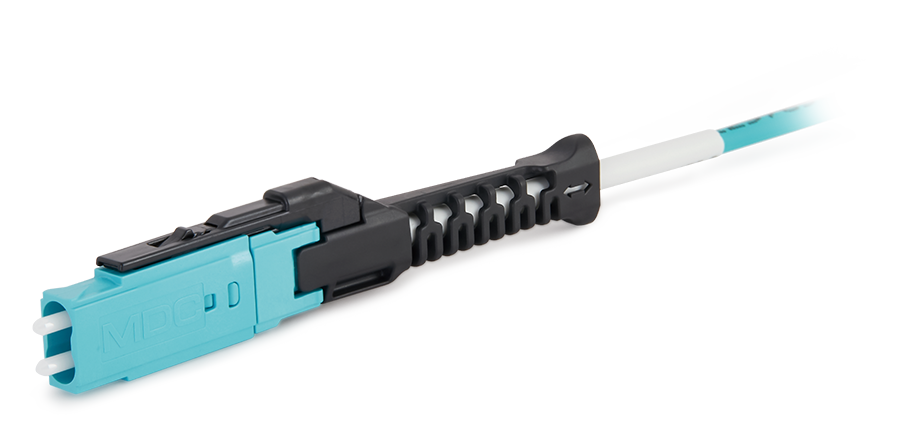 MDC Solution
US Conec's MDC connector is a Very Small Form Factor (VSFF) duplex optical connector, expertly designed for terminating single-mode and multimode fiber cables with diameters up to 2.0mm.
MDC Solution
US Conec's MDC connector is a Very Small Form Factor (VSFF) duplex optical connector, expertly designed for terminating single-mode and multimode fiber cables with diameters up to 2.0mm.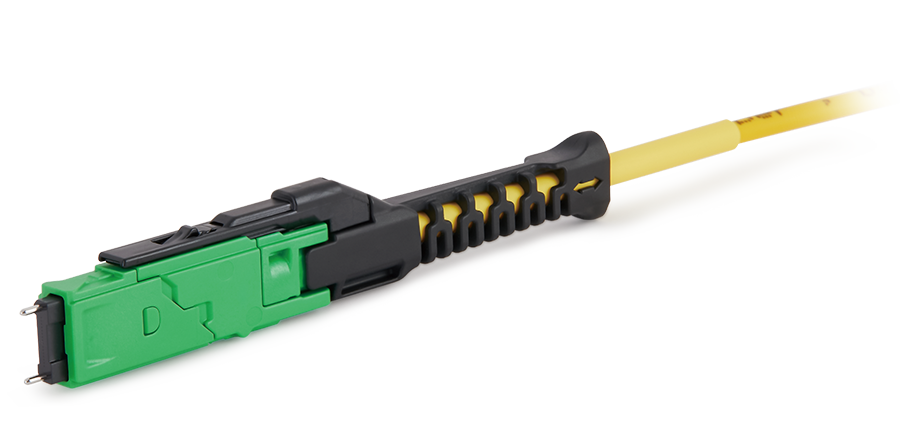 MMC Solution
US Conec's Very Small Form Factor (VSFF) multi-fiber optical connector that redefines high-density connectivity with its cutting-edge TMT ferrule technology and intuitive Direct-Conec™ push-pull boot design.
MMC Solution
US Conec's Very Small Form Factor (VSFF) multi-fiber optical connector that redefines high-density connectivity with its cutting-edge TMT ferrule technology and intuitive Direct-Conec™ push-pull boot design.